
Thanks so much to Dalia for today’s guest post! The post was edited minimally for clarity, and bolding was added by me to improve readability. (Side note: sponsored posts are not a thing on this site, but just to reiterate: this post is not sponsored. The goal of this series is to share real experiences of EV owners with the real vehicles they own. This means that sometimes we get in the nitty gritty details about particular vehicles, and sometimes people have very positive things to say!)
Q: First, a quick introduction! Could you tell us a bit about yourself, where you live, and what your driving needs are?
My name is Dalia and I live in Sacramento, California. I’m a dental hygienist, mom, small business owner and on the executive board of the California Dental Hygienists’ Association. I work in-office 2-3 days a week, about 10 minutes from home, and on my days off, I am working from home or at a cafe down the street. Needless to say, my driving needs are quite minimal on a daily basis. However, when the weekend comes, we really hit the road. We are driving upwards of 2-3 hours to visit family, check out a state park, hang at the beach, hit the mountains, you name it. That being said, I’ve put my EV through the gamut of real life experiences.
Q: When and why did you purchase your EV? Were you switching from a gas-powered car?
We purchased our 2023 Hyundai IONIQ 5 in December 2022. It was painstakingly researched from a variety of angles. One angle was that we were about to become parents and wanted a safe car. The IONIQ 5 had received a lot of praise for its safety features and crash test results.
Another angle was environmental responsibility. Before purchasing the IONIQ, my husband and I had driven a Acura MDX his late mother had purchased over 15 years ago. I couldn’t even tell you how many thousands of miles were on that car when we donated it to the Sacramento Zoo for the proceeds to go towards their conservation efforts, but it was a ton. The MDX was a guzzler, but we didn’t mind because it fit family comfortably on long road trips and we didn’t drive much on the daily. That being said, we saw an EV as the next step up in being sustainable since it would take us away from using fossil fuels, producing emissions and adding to noise pollution in our busy neighborhood.
Q: Tell us more about the car! Was it new or used? Why did you pick the particular brand and model?
We bought the IONIQ new (which was huge for us since we had been a 100% hand-me-down or used car family). We looked into hybrids first because we were a little nervous about going full electric. It was my father in-law who tipped us into the full electric camp. He has driven a Tesla for almost 10 years and has witnessed the flourishing of the charging infrastructure. He also demystified getting an at-home charging unit. We took the plunge after discovering a couple of rebate opportunities (link)(link) and apps that help you navigate long road trips with an EV (link)(link).

Allow me to break it down here:
- Point blank – I’m not a fan of Elon Musk or Tesla. It was a moral imperative for me to avoid a Tesla at all costs. On a more practical level, I was not a fan of Tesla’s giant touch screen as being the only way to navigate car functions like A/C and music. My father in-law has had a few close calls and a lot of frustration trying to do something as simple as turn the radio on. The IONIQ has a display that is both touch screen and analog buttons. It’s also a horizontal display which is familiar and feels less like you’re driving an iPad on wheels.
- Safety, with the new baby on the way, was highest priority. The IONIQ has continued to stand out for its safety. It has a great feature that prompts you to check the back seat when you exit the vehicle when the sensors notice a certain amount of weight on the back seat. As a new mom, who has heard of all the unfortunate stories of children being forgotten in cars, I was thankful for this simple feature in addition to all of the other safety features built into the car.
- During my research I learned that the IONIQ had a “quiet mode” feature which mutes all notifications and moves all audio to just the driver’s side door. Another baby friendly feature which I have definitely taken advantage of on road trips and when trying to get the kid to sleep on those tough days/nights. The car is also pre-loaded with a variety of nature noises and white noises, I can’t tell you how clutch these have been in soothing my kid or providing just the right kind of ambient noise to be a backdrop for long road trip chats.
Q: Walk us through the purchase process? Are there any federal or state financial incentives you were able to take advantage of?
There are a few funny stories that came out of us actually trying to purchase the car. It was nearly impossible to find a dealership that had any available. We put our name on 4 different wait-lists across multiple dealerships. At one point we got onto the Hyundai master wait-list, meaning that if any Hyundai dealership in the U.S. had one available, we would know right away. Zooming out, demand was way higher than we realized as casual consumers. This was probably because of a variety of industry factors like the processing chip shortage. Although this is what car-folks think is a bad memory of 2022-2023, we can see the demand for materials to build those chips rearing it’s ugly head as the dark-side of sustainability, which is mainly the human rights abuses and child labor happening in the Democratic Republic of Congo. This is an ethical issue that advocates for sustainability must address head on.
Zooming back in, our purchasing experience goes, we luckily heard from a dealership in Tracy (about 1 hour from where we live) and we leapt at the opportunity. When we arrived, the purchasing process was much like any other type of vehicle purchase. We kicked the tires, opened and closed all the doors and took a test drive. I went first, taking the car from 0 to 60 in about 4 seconds.
My father in-law, who has a pretty insane track record of negotiating prices and perks with a variety of big-ticket items, did his darnest to help us get a sweeter deal from Hyundai. In fact, we waited at the salesman’s desk for 2.5 hours in awkward silence as my father in-law insisted that we stonewall him into knocking off a few thousand dollars of the car. “We drove all this way!”, “Can’t you see my daughter in-law is pregnant!?”, “Maybe we will take our business to Tesla…”. He did his best, but at the end of the day, because the demand for EV’s is so high, we had no real negotiating power, there were plenty of people on the waitlists who would take the car if we didn’t. We didn’t even get a say in what color we got! I had my heart set on a sexy black EV. I was mortified to think I would have to take home a white car.
The end of the purchasing process was followed by an hours’ worth of IT work. We had to get set up with our Electrify America account. Upon purchasing the car, we got 2 years free charging at all Electrify America locations. This is standard with Hyundai purchases. We also got a crash course in charger types and how to maximize the life of our EV batteries (there are two batteries associated with any EV make/model (one that makes the car zoom, the other for ambient tech like headlights, radio, A/C etc.).
We were just barely able to take advantage of the federal rebate associated with purchasing an EV, but to my knowledge it has discontinued. (Yue note: Dalia was referring to rebate for EVs purchased in 2022 and before here. The federal government does continue to offer rebates for EVs, but the rules regarding eligible vehicles have changed. Find the latest rules here.) And the federal rebate was just a benefit we saw on our tax return the following year (2023), not necessarily a rebate we could put in our pocket to go towards purchasing an at-home charger or upgrading our home’s electrical grid. But hey, any assistance was welcome as we spent upwards of $50,000 on the car alone. We didn’t even have the option to opt for any features such as an automatic liftgate, programable seat and mirrors, floor mats etc. As I mentioned before, the demand was so high, we either took the car available or lived car-less for who knows how long. Talk about pressure!
At the end of the day, we are humbled by the privilege to be able to purchase such a car. We really don’t miss those features as much and a white car drives just as well as a black car. I’ve grown to love some features of the car that I think are really unique among other EVs.
Q: I think one of the big things that make owning an EV intimidating to people is the range and the logistics of charging. Can you describe how you manage this? Where do you charge? Do you take your EV on long drives? Have you found charging to be challenging?
Fear of charging logistics is a totally reasonable worry for anyone looking into buying an EV. It’s not as familiar or as quick as filling up a car with gas (it takes about 20-30 minutes to take a car from 20% to 80%, many EV car manufacturers encourage you to only charge to 80%, I can relate to the nervousness. It can be tricky if you’re not the planning type, but on the flip side, even for the most spontaneous person, you’ll find EV chargers galore in California. Most EV’s allow you to use the built-in navigation menu to filter out EV charging stations along your route. Even Google Maps, Waze and Apple Maps allow you to add EV charging to your route. Charging stations are typically in reasonably safe places like outlet malls, casinos, Walmart parking lots etc. If you open yourself up to the opportunity, these charging locations can be part of your errand runs, road trip bathroom break stops or a chance to explore a new part of town!
Let’s talk a little bit about batteries and chargers before I tell you about my experiences in the IONIQ. It is recommended that you let your battery get no lower than 20% and charge no higher than 80% to prolong the life of your battery. For the IONIQ, 80% gets you 221 miles. This amount of milage allows me to charge the car 1x/week. At 100% the IONIQ gives you 300 miles. In other parts of the country, this can get you to a lot of different places. In California, it barely gets you to L.A. For example, when I was planning a trip to Costa Mesa, CA (about 420 miles) in March I had planned to stop at the Tejon Outlets, right before the grapevine, to charge. (Due to different circumstances, we ended up taking a gas vehicle to Costa Mesa.)
Before I talk about charging infrastructure and types of chargers, I want to make sure I touch on a less sexy but important point of driving and EV (or even a hybrid vehicle), which is regenerative breaking (I’m a visual learner when it comes to things like this, so here is a YouTube video). With our car, there are 3 modes you can choose from which adjust the sensitivity of your regenerative breaking. This is handy with different terrain.
For example, if there’s a lot of downhills, you can increase the sensitivity to regenerate more energy from coasting and breaking. If it’s flat with a lot of stop-and-go traffic (i.e. everyday errands, in-town driving), you can stay in the middle to generate more energy at stop signs/lights or when driving below 40mph. I grew up playing a lot of racing video games, the quick adjustments and optimization of driving an EV and hybrid (my first car was a 2000 Honda Prius) was something I saw as a skills challenge and made getting the highest mpg a game.
All that being said, if you have a lead foot, you might run out of charge per mile faster. Coasting, driving the speed limit and being slow to accelerate are ways to maximize the distance you get per charge. Like I said, not sexy, but it is something you want to keep in mind when trying to manage charging and battery life.
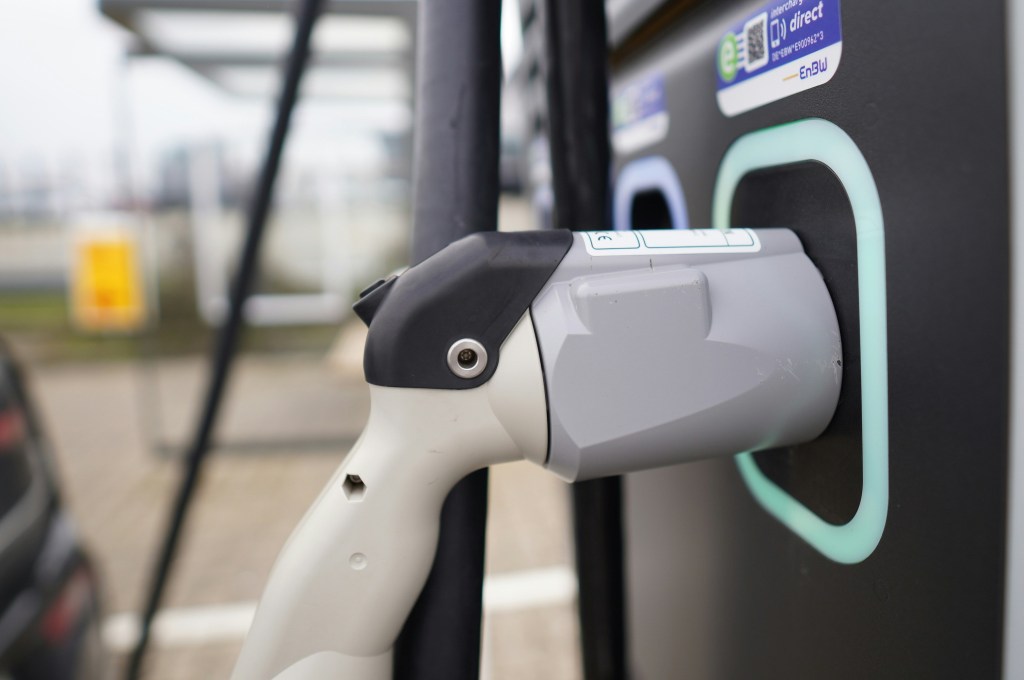
Okay, let’s talk chargers. There are three different types of EV chargers out there:
- Level 1: 3 to 5 miles added per hour of charging, typically used at home using a 120 V outlet (we used this while staying with my parents for the weekend, our car plugged into their garage outlet for 2 days to go from 20% charge to 60% charge, which was enough to get us home).
- Level 2: 25 miles added per hour of charging, requires 240 V outlet (which we had to get installed by a professional in our home in order to support charging our car at home). In 4-8 hours you can go from empty to full, great for overnight charging so that your car is ready to go for the morning commute!
- DC: this is the fastest, can go from empty to 80% in 20-30min. Many car manufacturers recommend using this type sparingly to prolong the life of your battery. When you see a charging station in the wild, it is most likely a DC station. This is great for road trips or if you forgot to plug in your car the night before (a common occurrence for sleep deprived new parents…speaking from experience).
It took us about 5 months to get an at-home, level 2 charger after purchasing our EV. Again, due to demand, it was difficult to find anyone available to install one. But once we did, it took all of 2 hours for him to install it. We could program on our IONIQ app for charging to start during off-peak hours (from midnight to 6am is all it takes for us to get to 80%).
The longest road trip we’ve taken with our IONIQ has been about 115 miles (Sacramento to Fremont). Our car was stuffed to the brim with boxes of baby stuff and three passengers (myself, my husband and the baby). We started with 80%, and arrived at our destination with 40%. When I drive that distance by myself, I typically arrive with 47-50%, so the weight of your load (as well as how you break/accelerate) has an effect on your charge per mile efficiency.
When I drove a gas car, I was one of those weirdos that got as close to empty as possible before filling up. It took a few days to switch that mindset to one that likes to hover between the 80-20% sweet spot. We were able to exercise that amazing human ability to adapt, and I’m confident that that no matter how nervous you are, you’ll be pleasantly surprised by how easy you’ll fall into the pattern of the new normal once you’ve purchased an EV.
Q: Concluding questions: what do you love about the EV you have? What do you not like? What would you tell folks who are curious but feel hesitant about making the switch to EVs?
Real talk, there’s some things I hate about my EV. The list is petty and short, and most of it has nothing to do with car itself but is about Hyundai, charging infrastructure and controllable features. I hope my transparency helps paint an idea of EV ownership and driving experience that helps others make informed decisions.

What I hate:
- Lane assist is extremely handy when driving long, uninterrupted distances, but you can bet money that I’m turning it off when driving around town. It doesn’t read merging lanes very well and is very sensitive to adjusting to bike lanes, parking lanes and even old and faded lines on the road. Call me a control freak, but nobody drives my car but me, and I hate it when lane assist corrects me. Thank goodness I can turn it off.
- 3 months into owning the car there was a massive storm in Sacramento. A rock hit my windshield (my motto is “nothing stays new forever” but I definitely cried literal tears when this happened so soon after buying a $50k car). Traditional windshield replacement companies (i.e. Safelight, AAA, Glassdoctor etc.) refused to replace my windshield. Even Hyundai doesn’t replace windshields (the time, effort and expertise in re-calibrating the sensors that are attached to the windshield seem to be the primary reason why Hyundai and other companies don’t help: link). It is still beyond comprehension to me. The chip on the windshield remains, and everyone still refuses to replace it. Insult upon injury. Yes, I’m still bitter.
- DC charger etiquette is atrocious. While we were awaiting the installation of our home charger, I frequented local charging stations. There is nothing worse than going and finding a gas car flagrantly parked in an EV charging station. Also, there is a 10 minute time limit once a car has finished charging, otherwise you incur a certain fee per minute you remain plugged in. I’ve waited upwards of 1 hour and 20 minutes waiting for EVs that have finished charging to move. Sometimes another EV would poach a spot that I was waiting for. Sometimes a driver, who didn’t think that I would notice, would unplug my car to plug theirs in. Needless to say, that when you charge at a popular station you have to exercise some patience and good manners, or just look for a new spot to avoid the aggravation of dealing with other EV drivers. I was happy to kiss charging stations goodbye when our home charger got installed.
What I love:
- I think in another life, I would have been a really good racecar driver. The way my car handles turns, the smooth, gearless acceleration, the built-in ‘sport’ mode…it’s a really fun driving experience. I’ve never had this much fun driving a car.
- So quiet. I can actually hear folks talk in the back seat, my music comes through the speakers crystal clear without me having to blast it over the noise of the engine, and after a day of dealing with patients and the babbles/cries of a baby, a silent drive is heavenly.
- The IONIQ dashboard is a perfect blend of digital and analogue. I don’t have to fumble for to adjust the A/C, navigation or entertainment because there are literal buttons instead of endless touch-screen icons. It really feels as normal of an interface as any gas car you’ve probably driven.
- The frunk (front trunk). It’s a handy space that houses emergency roadside items. When you have a baby, any extra storage space is nice on a road trip. Imagine filling the whole thing with diapers and wipes while the trunk in the back has snacks and suitcases. Just glorious.
- The rearview camera is crystal clear and to-scale. I’m a unicorn in my family, meaning that I drive backwards with ease and can parallel park accurately with zero hesitation. My husband (sorry, my love) isn’t as confident, but the IONIQ rearview camera is so accurate that even he can do it!
- Hyundai customer service and maintenance (with the exception of the windshield debacle mentioned above) is super responsive, quick and convenient. Any software update issues, recalls or even regular maintenance (like tire rotation, fluid level checks etc.) haven’t taken a huge bite out or our day.
As our in-town, commuter car, we are extremely happy with our EV. I would encourage anyone who is in a similar situation to consider an EV. That being said, we are looking to buy a hybrid as our second vehicle as we love taking road trips and foresee a need for a larger vehicle to accommodate our growing family. In order to preserve the longevity of our EV, we don’t want to run it to the ground and exhaust the life of the battery by making it anything beyond an in-town commuter vehicle.
Thanks again to Dalia for sharing your EV experience with authenticity and humor! I hope this interview is helpful for potential EV buyers. You can find Dalia at @freshtakesed and @verbca on Instagram.
 Sensible Sustainability
Leave a comment