
I loved reading James Hamblin’s book Clean: The new science of skin and the beauty of doing less. It really is my favorite kind of book: non-fiction that is super readable and backed up by research, inspires me to think about my everyday practice but also explores the topic in larger historic and societal context.
Here are my key takeaways:
- Our skin is home to trillions of microorganisms. The scientific understanding of why these bacteria, fungi, viruses, and mites (yes, even mites!) exist and what they do is nascent, but by overwashing our face/body/hair, we are disrupting a delicate ecosystem and removing a lot of potentially good and necessary stuff. Like, gut microbiome health is all the rage and everyone is all about kombucha and kefir, yet we are soaping our body daily and killing everything with antibacterial soap?!
- Many skincare products have no evidence base whatsoever (e.g., topical collagen) and it’s just pure marketing. Some hygiene practices – like handwashing – are important, but most of what we think of as “cleaning” really has nothing to do with hygiene and doesn’t necessarily improve our health. In fact, there is evidence that being overly clean hypersensitizes our immune system and increases risks for immune-driven diseases (e.g., food allergies, eczema).
- If your skincare routine is serving you, there is no reason to change or think you are doing something wrong just because it defies social norm. There is no shame in not shampooing your hair or showering (in the traditional sense; most people who stopped showering still “wash their bits”), even though we should absolutely acknowledge that some groups in our society are judged more harshly for not adhering to traditional beauty standards. (I mean, there is a reason why this book was written by a cisgender white man who can declare to the world that he stopped showering and not suffer any professional consequences!)
- On an individual and societal level, we are far too invested in superficial solutions (think supplements, prescriptions, skincare products, etc.,) while ignoring the foundations to good skin and overall health – clean water, air, healthy food, public green spaces – all things that encourage a safe, active and engaged social lifestyle!
Having grown up indoctrinated with impossible eastern Asian beauty standards, I often question if I should be doing more or try the latest products, even though I am blessed with relatively good skin. Social media ads and algorithms certainly don’t help! If anything, this book has helped me tame the voice in my head that doubts some of my own “weird” practices (e.g., I don’t usually use body wash and have never used deodorant in my life) and given me more confidence in sticking to a few evidence-based practices and products.
Contrary to some of the flashy headlines surrounding the book, I do not think the author is advocating everyone to stop taking showers. We do what we do for many reasons; lots of people find pleasure in the ritualistic aspect of bathing and skincare. But you should feel empowered to do less – much less – if that’s what you want 🙂
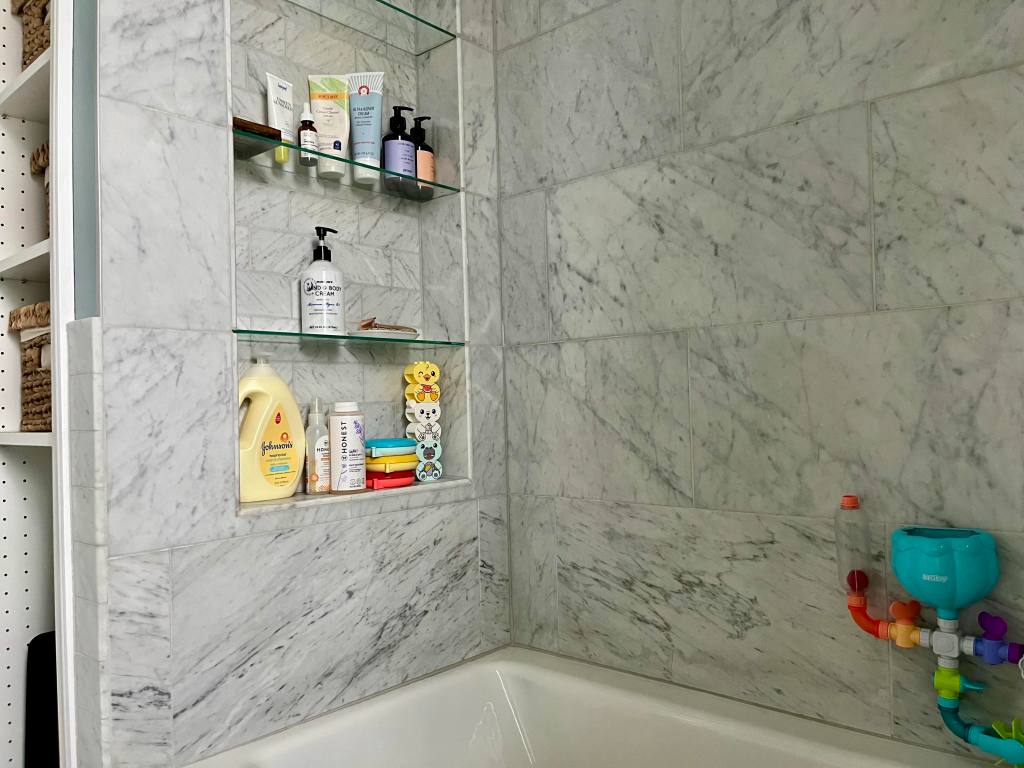
A shelfie! I know – how influencer of me! (Also, tell me you are a toddler mom without telling me)
My current routine
- Handwashing: having a toddler that brings germs home from daycare everyday, frequent handwashing is a must! We buy liquid castile soap from local refill stores and dilute 1:3 soap to water (this only works if you use a foaming soap dispenser). I love that we can get unscented soap and how affordable this is. I avoid antibacterial hand soap (read more on why here) and use hand sanitizers sparingly (hard to completely avoid being out and about with a kiddo that seems to snack constantly, ha!)
- Sunscreen: personally I find sunscreen really annoying, so I buy formulas that I really like as a way to encourage myself to wear sunscreen daily. Currently I’m using Supergoop, but I’ve also liked facial sunscreens from Innisfree and La Roche-Posay. I’m no expert and don’t stay on top of the latest products, but these brands all have formulas that don’t leave a white cast or feel greasy.
- Other skincare things: I mostly use water to wash my face and body but will sometimes use a mild facewash (e.g., to wash off makeup). I follow that up with a moisturizer. I’m not picky about brands and often get drugstore brands or whatever is available at local refill stores. If I’m feeling fancy, I might use some retinol at night after washing my face and before applying moisturizer. (Be sure to use sunscreen if retinol is part of your routine!)
- End of life: I try to get refillable products as much as possible, but if there are materials that aren’t recyclable through municipal recycling, I use Terracycle to find either a local drop-off spot or a mail-in option for recycling. Recycling programs come and go, so I have used different programs over time. This is annoying but not terribly cumbersome since I only recycle once I’ve collected a big box of bottles, caps, and pumps, so this is only a once or twice a year problem.
Additional reading and resources:
- If you are a skincare science and chemistry nerd, you will love Lab Muffin Beauty Science
- FryFace is a dermatologist-founded site that helps you find affordable and basic products; I really like the premise of the site!
- From Science vs: skin Care: is anti-aging a scam? (podcast)
- Marisa Meltzer | Glossy: ambition, beauty, and the inside story of Emily Weiss’s Glossier. I recently finished this book (in audiobook format), and wow – if you want to know just how much skincare and beauty products are really about marketing, read this book asap!
Header image credit: Matthew Tkocz via Unsplash
 Sensible Sustainability
Leave a comment